
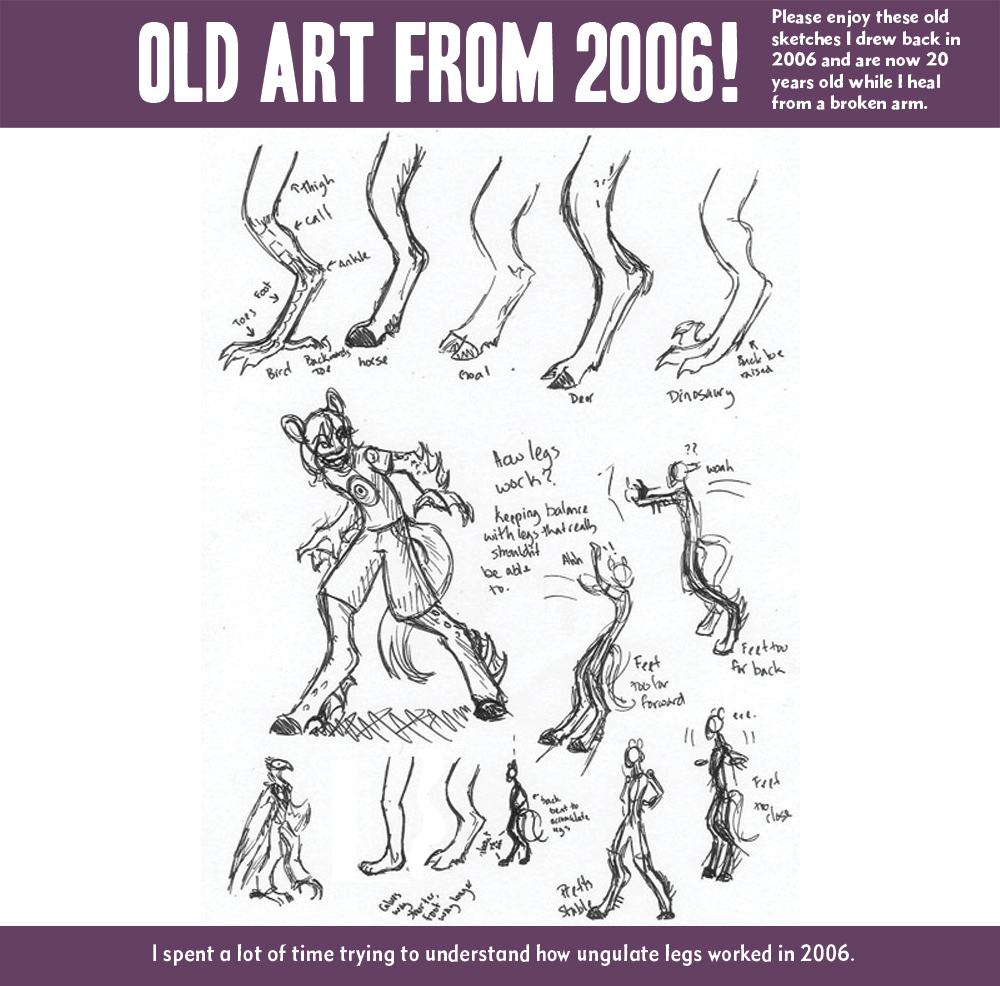
I used to draw in sketchbooks all the time and most of the pages looked something like this. I was trying really hard to figure out how the HECK ungulate legs worked because they were different than other digitigrade legs (technically ungulates stand in an unguligrade stance) and it BUGGED ME until I figured it out.
6 Comments
I’m still trying to figure this out. I see other folks’ art that looks good to me, but that never quite translates to my own drawings in a way that feels “right” to me (for lack of a better term). I keep wondering, “Is this comfortable for the unguligrade person? Can they easily stand in one place, or are they constantly having to shift around to stay balanced? If it works well enough for a slender, light person, what about a big, brawny, or otherwise heavy person??” And then I draw human-shaped legs instead (sometimes with hoof-toes). :)
As far as I can tell, the trick for balance is to draw a straight line up from the main part of the foot that rests on the ground, whether a hoof or talons, up to the hip-joint.
Get those aligned directly above one another and the rest should usually fall into place. This works for if you do more humanlike proportioned legs and a full animal foot or go for the more feral look of shortened calves.
I know exactly what you mean. I spent an afternoon sitting in the middle of a petting zoo, drawing goats until I got it right.
Dude. I’m new here, but as I was reading the archives I had to take like an hour break to think about the comparative anatomy. Legs is weird.
Ready to have your mind blown? Cetaceans (whales, dolphins, and porpoises) are ungulates. They have a direct ancestor with hippos, and their flippers hide a complete foot. They’re also the only mammal with hyperphalangy: more than three phalanges per digit.
I learned quite some time ago that the ‘backwards toe’ as a lot of people call it is a ‘hallux’ and is generally analogous to the big toe. Or if you like to see the foot more handsy, the thumb.